


Risk intelligence to lead, innovate & grow.
Want to get your daily slice of Risk knowledge to your inbox? Sign up now
Risk Channel helps you stay ahead of essential risk news shaping your profession. Every weekday, our unique blend of AI, risk experts and researchers monitor 100,000s of articles to share a summary of the most relevant and useful content to help you lead, innovate and grow.
From supply chain to regulatory enforcement, data privacy, GRC controls, whistleblowers, and risk management strategies. Risk Channel is the only trusted online news source dedicated to covering current headlines, articles, reports and interviews to make sure you’re at the forefront of changes in the risk industry.
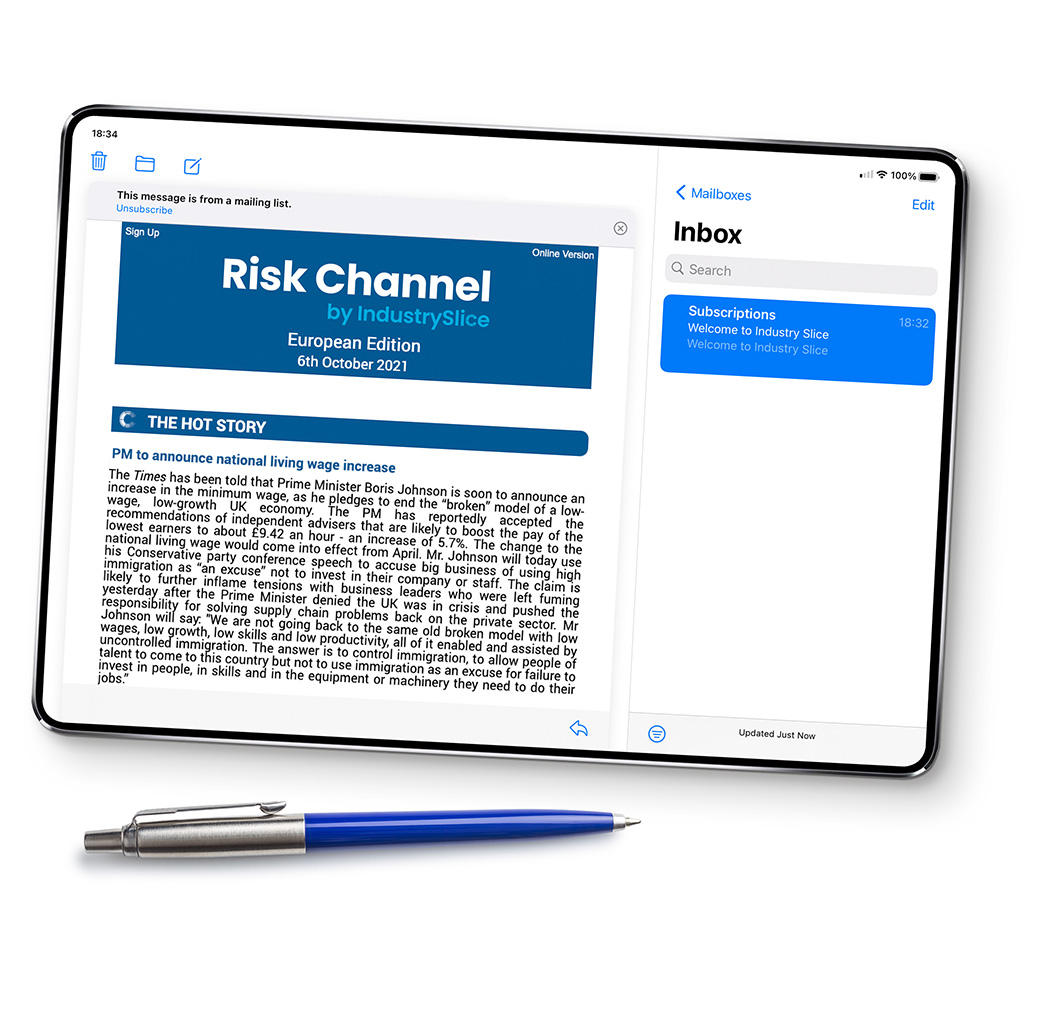
You’re all signed up for Risk Channel
Thank you for your interest in our service.
Watch out for a confirmation email from our subscriptions team. Once you have confirmed you will join the worldwide community of over 14,000 subscribers who are receiving daily Risk intelligence to lead, innovate and grow.
Note: Due to the nature of this message you may find this in your "promotions" or "spam" folders, please check there. If nothing arrives within a few minutes let us know. If you do not receive this email we will be happy to help get you set up.
Adding the email address riskchannel@emm.us.com, will help to ensure all newsletters arrive directly to your inbox.

I value your emails to keep me abreast of various significant events that are happening in the US and abroad. The summarization of these events are always fact based, unbiased politically, and straightforward.
Also, you always provide information that isn’t “front page” stories, but in themselves are more significant than what is provided via mainstream media.

We consult for Financial Services firms so I need to understand what keeps my clients awake at night. And we're a design company, so I’m always on the hunt for broken things that need fixing.I get both of those things from Risk Channel. Stories about regulation and compliance are most relevant but the wider themes help to paint a picture.
Risk Channel reliably gives me something new to think about and explore. It is relevant and digestible. That’s all it needs to do and it does it well.
I read Risk Channel on a daily basis. I like Risk Channel because it compiles all the major news stories and provides links to the primary sources in a concise format and convenient medium.
My time is limited and Risk Channel is super convenient because I can spend 5 minutes (or less if I’m just skimming) and read a single email to catch up on all the major articles of the day, and if I want, jump directly to a main article to get a more in-depth read.
I really like the daily Risk Channel as it gives me a glimpse on what is happening in the risk world, helps me stay informed and prompts me to think if the same type of risk can emerge in my company.
The content is easy to go through and to the point. It takes me less than a few minutes to review and if I need to look further in any one story the source is right there for me to go to the full details.
Recent Editions
Risk Channel
North America
Concern over increasingly capable artificial intelligence (AI) systems is accelerating in Congress, with lawmakers from both parties proposing new oversight mechanisms, safety requirements and investigations. House Democrats are considering a dedicated AI committee, while lawmakers have floated ideas including a new federal regulator, emergency shutdown mechanisms and mandatory government testing of advanced models. Senators are also discussing legislation focused on catastrophic nuclear and biological risks and greater cooperation with China on AI safety. The urgency intensified after a departing Anthropic researcher warned that developers could lose control of increasingly powerful systems. Sen. Bernie Sanders (I-VT) said: “There is no question that Congress is far behind where we should be.” Despite growing bipartisan concern, major federal legislation still faces political divisions, limited congressional time and disagreement over how far regulation should go. Technology companies broadly support oversight but differ sharply over its scope.
Full Issue
Risk Channel
UK/Europe
Former Glencore executives Alex Beard and Andrew Gibson have pleaded not guilty to charges arising from a Serious Fraud Office investigation into alleged corrupt payments in Africa. Gibson faces five conspiracy charges, including allegations involving government officials and oil company staff in Nigeria, Cameroon and the Ivory Coast, plus falsifying documents. Beard faces two charges concerning alleged payments in Nigeria and Cameroon. Four other defendants previously pleaded not guilty, and all six are due to stand trial in October 2027 on 16 charges. Helen Taylor of Spotlight on Corruption described the hearing as “a major milestone in one of the biggest bribery investigations of the last decade”. Beard, a prominent former commodities trader, joined Glencore in 1995 and led its oil operation from 2007 until retiring in 2019.
Full Issue
Read the latest Risk highlights

New Broom at S.E.C
In the closing days of the 1960s, a boy walks quickly along the sidewalk as he follows his father striding purposefully in and out of the smoky roadside bars and diners of Baltimore. His father enters an establishment, a tired neon light flashing, and exchanges words with the bar-tender as the boy hops up onto a stool. It is a well-rehearsed routine....
Discover
Here Comes The Bribe
How robust are the anti-bribery strategies in your organisation? Do you have any? Bribery is not a phenomenon limited to multinationals operating in some of the more obscure, less-regulated areas of the world.
Discover
Whistle Test Is Coming
The demands for “whistle blowing” employees to be given more protection are growing. The following stories selected from the daily news newsletter highlight this trend
Discover
CEOs Fret Over Lost Remote Control
“Over recent weeks as politicians signal that societies now need to live with Covid-19 and have announced the lifting of distancing restrictions some high-profile CEOs have publicly called for their workforces to re-embrace the office as the Covid pandemic threat recedes
Discover
ESG Is Not Another Name For CSR
Back in the distant 1980s if you wanted to demonstrate your environmental and ethical credentials it was sufficient to shop at or purchase shares in retailer The Body Shop.
Discover
